-compressed.jpg)


Daily, snackable writings to spur changes in thinking.
Building a blueprint for a better brain by tinkering with the code.
subscribe
rss Feeds

The first non-fiction book from Tinkered Thinking. PAUSE is a short book on meditation. Now available on the Tinkered Thinking Bookstore.


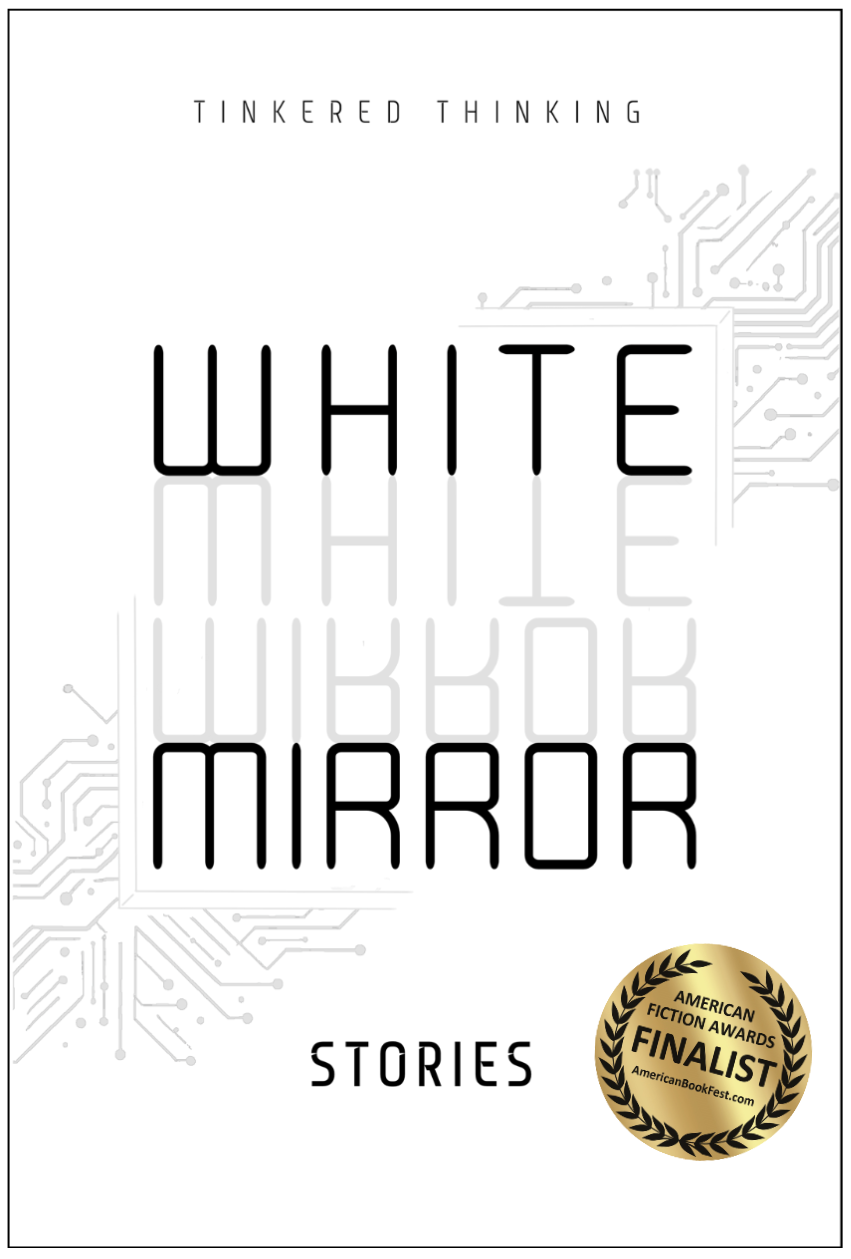
The SECOND illustrated book from Tinkered Thinking is now available!

SPIN CHESS
A Chess app from Tinkered Thinking featuring a variant of chess that bridges all skill levels!

REPAUSE
A meditation app is forthcoming. Stay Tuned.




THE AGE OF AGENTS
October 10th, 2026
Kevin Kelly has an infamous essay entitled "One Thousand True Fans". The premise is achingly simple: if you are a creator of some kind, and you can amass 1,000 people who love absolutely everything you do and will buy anything and everything you put out, then if they all spend $100 on your art, then that's 100 grand a year. It's a dream come true for any creator. And the internet certainly seemed to hold that promise. And for many that promise has been fulfilled. But it takes dedication, perseverance, and not a little luck. But the age of agents has the potential to supercharge this equation.What if you could automate luck? Sounds silly but it's essentially what every stock trader has dreamed of since the invention of computers. It has different names in those circles. You'll hear of arbitrage and asymmetric upside. Jargon like that.
Of course it depends how you define luck. I've written about it here and there over the years and I think it has mostly to do with perspective. It's hard to get lucky if you see the exact same thing every day. Your perspective is limited. And given the fact that humans become deeply inured to what's familiar, it's less likely you'll spot some arbitrage in your daily routine the longer you go about that daily routine. What exactly do I mean?
Luck is noticing something useful that no one else has. Wait a minute, isn't luck winning the lottery? Well, you can't win the lottery if you don't play. The odds are abysmal but the point stands: the person playing the lottery is trying to unlock an arbitrage. The problem is that such people fail to consider the odds. And even worse, such people fail to realize the opportunity cost of expending time, attention and money on a game that has such low odds of success.
Think of MacGyver. If you're not familiar this was a show where a protagonist always seemed to get into strange and daunting circumstances, and he would look around him and rearrange the ordinary items around him, usually, to escape some room he was trapped in. Many people might watch a show like that and say, oh, he's clever.
But what does it mean to be clever? It means looking around you and seeing an arbitrage in an item that someone else would overlook as useless for the current situation. That's clever, not luck, right?
The other day I had to refill an engine with oil. The cap was on damn tight and the tiny handle on it didn't leave much room to use brute strength. It was barely big enough for my fingers to apply any pressure. I was at a friend's house and walked into their garage. As luck would have it... they have virtually no tools in this garage whatsoever. No wrenches or pliers, not even a hammer. Nada. Not particularly lucky. But then I found what I think was a pneumatic pump of some kind. I was missing the long tube that one would use as a lever to charge it. It was basically a very heavy, enclosed cylinder with a small structure on the side to fit a tube to pump it. I picked it up and turned it over. The lever structure was designed in such a way that it had a slot in it, and as luck would have it, that slot looked just about the same size as the oil cap's handle. I brought the weird contraption over to the engine, and tried to fit the slot over the oil cap handle. It slid in perfectly, and with the heavy cylinder attached, I had a solid grip. I barely had to twist the whole thing and the cap gave and spun. I felt pretty lucky.
But was I lucky or clever? It depends on your perspective. An outside observer who isn't particularly handy would likely watch the episode and think I was clever. But I didn't think I was clever, I was too busy feeling lucky.
So what does this have to do with agents, the internet and 1,000 true fans?
It's all about perspective. The internet has always been a bit of an odd place to navigate. It has no geography. The landmarks are always in the same place, but they have no discernable geographic relation to one another. Google is always at google.com, but where is Google in relation to Reddit, or Twitter, or Facebook? This is a nonsensical question, but one worth considering. Humans navigate by geography. But the internet is kind of like human memory. If you forget about a website, it basically ceases to exist. Perhaps you'll find a link to it on some other site but it's just not the same as walking down a street in your hometown that you haven't visited in a while and remember the book shop you love is just around the corner. The point is the internet has never been a 3 dimensional place and while we've all had the experience of browsers that begin to lag because there are 175 tabs open, those endless tabs are schizophrenic in their position with one another.
So how do those mythical 1000 fans find you in this schizophrenic landscape? Of course it's still possible. Repost things on X, or Facebook, or Instagram, Reddit, Tik Tok, etc. One goes viral, and a bunch of people find you. There's all sorts of jargon for gaming this too. But instead of listing it all, I just want to point at the possibility that it might all go away.
Personal agents are on the rise. I use a few different agents and their capabilities are expanding rapidly, and impressively. People are starting to hand over their Credit Cards to their agents so the agents can book that trip of buy that thing. Someone unacquainted with the cutting edge of AI might shudder in horror at the thought of doing such a thing, but this stuff is solidly poised to be inevitable. It's worth considering what the new world looks like on the other side of the change:
Imagine your agent knows just what you like. The sort of literature you like, the sort of philosophy or thought provoking content, or mindless drivel, your style in clothes, in home decor, the sort of trinkets and tools you like. Imagine it's so good it can basically pick out the best present for you everytime, better than any of your loved ones. I'm not saying you have to believe it'll happen, I'm just asking you to entertain the hypothetical for a moment.
Now imagine that agent has the ability to crawl the internet 24/7. In fact in a few months it can scour the internet more thoroughly then the ten people closest to you have done in their entire lives, combined. Think of all the options it'll have on hand when you ask for something.
Now think about what this means for the creator who has things online.
The luck of the creator might drastically increase because the perspective of every potential customer is about to expand by several orders of magnitude. People who would love what you've done, but never had the time or the attention or the happenstance to stumble across your work are now going to have an agent find you. The creator's luck expands because the surface area of the consumer's perspective is about to expand. The two are one in the same. A creator is only as lucky as the surface area of perspective of potential customers. This is why marketing is often such a drag: you're trying to compensate for the tiny amount of bandwidth that potential customers have by making a huge attention-seeking racket. But the Age of Agents might put an end to this silly charade. . .
I'm making an asymmetric bet when it comes to the Age of Agents. I'll be launching... at least 5 new book projects in the next month or two. That's right, five books. Even I can't believe it, but they are all done.I may have sixth that's also almost done, but it might wait till next year. The bet I'm making is that agents will help people find Tinkered Thinking far more efficiently than the human-navigated internet did. Personally, I'm launching a few other ecommerce stores for things unconnected to Tinkered Thinking because 1. it's so damn easy to do that now — I basically copy and paste the code for my Tinkered Thinking Bookstore and have a coding agent revamp it for a different brand/product. And 2. I don't think this other products will need marketing in the traditional sense. I think such products will simply need a page for an agent to read to get a very clear idea of what the product is, and then voila.
Imagine a parent who has an agent, and the agent says "Hey, I just found this new children's book, the visuals are great, and I just read it, and its philosophy is very inline with what I know you are hoping to instill in your kids. Would you like me to order it? Oh and it's the perfect length for reading at bedtime. Not too long, but not too short, it's just right." What parent isn't going to say SUREE, get it.
I think this interesting window is about to open, and it could mean a big bump in the discovery of creatives who have put themselves and their creations online. But I could be wrong, we'll see. Regardless, the Age of Agents is upon us. I for one think it'll be for the better.