-compressed.jpg)

Daily, snackable writings to spur changes in thinking.
Building a blueprint for a better brain by tinkering with the code.
subscribe
rss Feeds
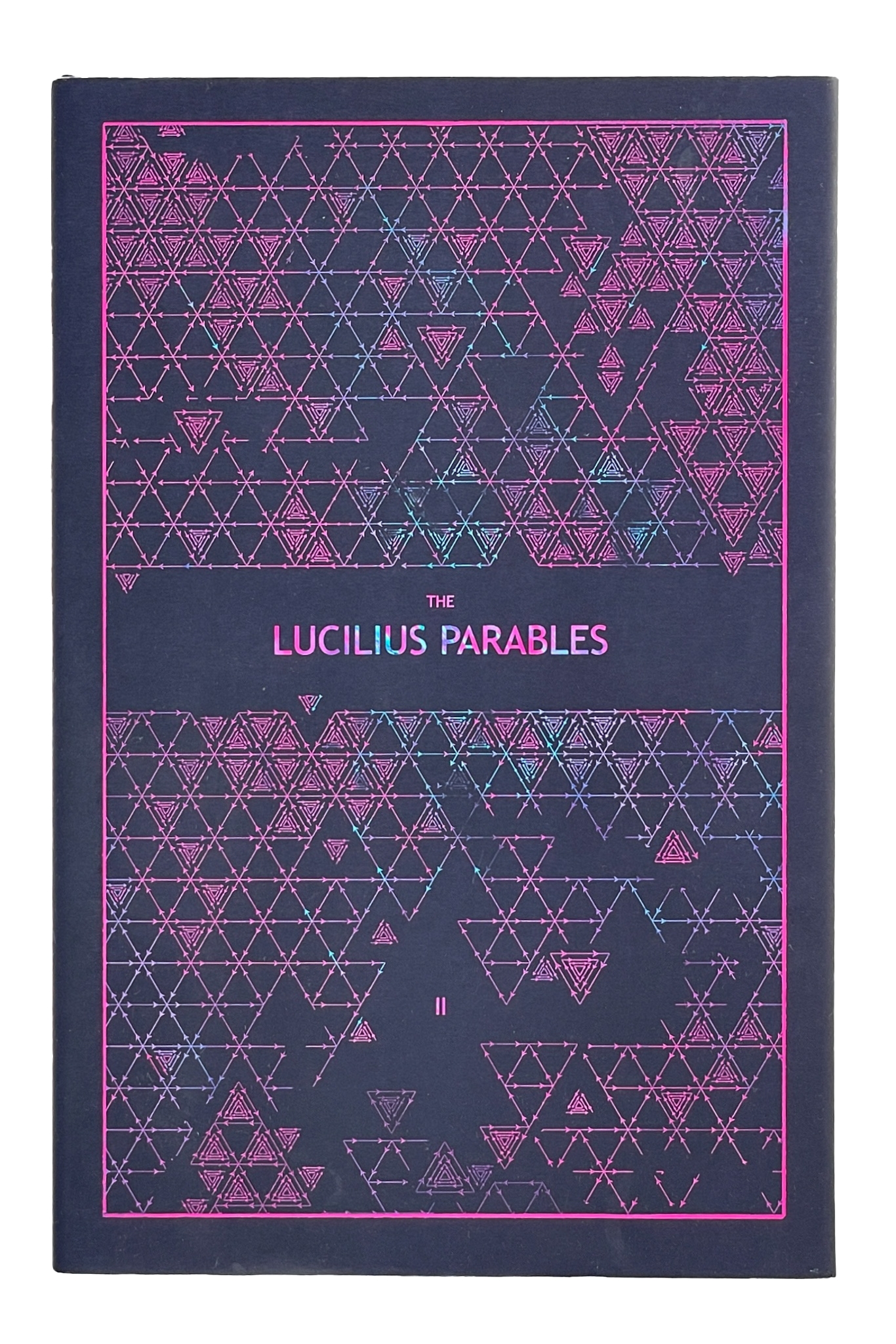
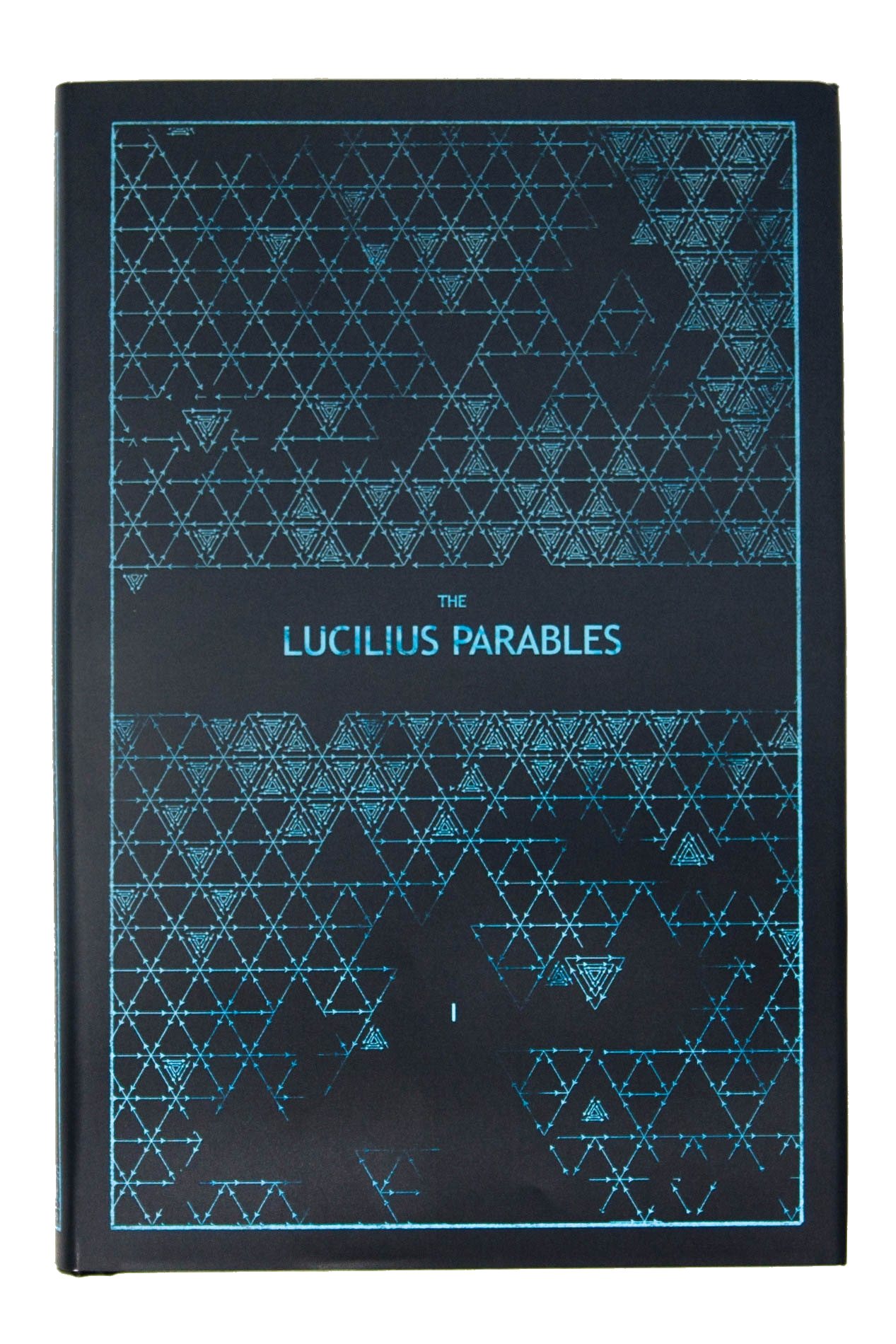
The SECOND illustrated book from Tinkered Thinking is now available!

SPIN CHESS
A Chess app from Tinkered Thinking featuring a variant of chess that bridges all skill levels!

REPAUSE
A meditation app is forthcoming. Stay Tuned.




A LUCILIUS PARABLE: GRAIN OF SALT
November 17th, 2019
A distant screech of metal called out from whining hinges. Some heavy gate that Lucilius had once seen clattered shut and echoes of cold iron reverberated down the silent corridor.
Lucilius felt the two rings of his nose slowly warm and turn cold as he breathed, his pulse rippling out to his limbs, quickening and seeming to pause as it slowed in rhythm as his lungs relaxed. The cement floor was cold, seeping the heat from him, but Lucilius was content. A shuffle of sound grew, footsteps emerging until they stopped next to the cell where Lucilius sat. Another metal door opened. The cement floor clapped with the flat slap of someone thrown down. The door clanged shut and guards walked away. Lucilius watched a thought rise up and fill him with wonder about who might be a neighbor to him now. He could hear the man groaning in pain but after a time he fell quiet. And each day, when the small slider at the bottom of each cell door was opened, Lucilius could hear his neighbor scurry forward to the tiny bowl of food. Lucilius would listen to the clawing rasp of the man’s fingertips gathering every last grain of rice as he watched his own untouched bowl at the front of his cell. And each day after Lucilius was finished with his meditation, he would take the tiny amount of rice in the bowl and add it to a white block of packed rice that he kept wrapped and hidden high in the wall where the mice could not scale.
After several weeks with his new neighbor, Lucilius began to hear muffled scratchings. He moved and sat in meditation each day facing the wall where the light sounds seemed to come. Each day they grew a little clearer until one day Lucilius opened his eyes while meditating and several moments later, a brick in the wall began to budge. It wiggled and then began to emerge from the wall. It tilted at the edge of the boxy hole, hanging a moment, and then popped out. Lucilius leaned forward while sitting and looked into the hole. Through the wall Lucilius saw a pair of eyes grow wide as his neighbor let out a startled cry and jumped back. The two of them each looked at their own cell doors, listening for any movement of the guards. Footsteps slowly tapped out the measure of the long corridor, growing as they neared, pausing at the end and then turning back, meting out the distance once more.
Lucilius bent forward again and looked through the hole. Eyes met him again.
“Hello,” Lucilius whispered.
“Hi,” the neighbor said. “I’m so hungry. How long do people last in here?”
Lucilius wondered about the question a moment, remembering the many times he’d listened to the sound of a body being dragged down the corridor. How many had he heard over the years? All up and down the corridor seemed to light up with sound in his mind, and he realized then that it’d been quite a long time since he’d had a neighbor, the two cells on either side of him being empty for almost the whole time he’d been there.
He got up and removed the hoarded block of rice from it’s place high in the wall. Returning to the window with his neighbor he carefully fitted the brick of food through the hole. Gently pushing and pulling, the two shimmied it through until Lucilius’ neighbor plucked it from the tight slot. The man unwrapped the cloth and then gasped.
Wide eyes briefly looked up at Lucilius. “What? how-“ But the man could not finish his questions as he began shoving the packed rice to his mouth, his eyes glazing over, the focus leaving his face. Lucilius smiled watching the man eat his fill. Before the man could even finish the brick of food, he stopped himself, groaning from the fill for a stomach so starved. After he recovered, smiling, his face grew confused.
“How do you have so much food?”
“I save it all week,” Lucilius said.
A look of shame and guilt and horror flooded his neighbor’s face. “You must be starving!”
Lucilius shrugged, “Hunger is like shit, the more you eat the more you have.”
“What?”
Lucilius looked around him at the comfortable walls of his cell.
“Here, in this place, they feed you just enough to stoke your hunger, like a fire that burns and tortures you. And just before that fire goes out, they throw in just a little more fuel…. but if you refuse that tease for a few days, you stop feeling hungry, the fire of hunger goes out. I save the food and eat once a week here. Then I have a couple of days of hunger and then I’m at peace for the rest of the week until my next good meal before the rice goes bad.”
Lucilius’ neighbor looked at him, stunned with knit brows. “Is that healthy?” he asked.
Lucilius smiled and looked around at the cold stone walls of his cell. “Funny question.”
He pulled back a moment, letting the notion roll around in his mind.
“The body is like anybody else. Important to listen to, but. . . perhaps best taken with a grain of salt rather than a grain of rice.”
RESOURCEFULNESS
November 16th, 2019
The essence of resourcefulness is captured by a seemingly unrelated aphorism:
One man’s junk is another man’s treasure.
This aphorism is generally used to highlight preference differences between people. But just a subtle step in the right direction casts this with a new perspective, in fact the aphorism is all about perspective.
The item in question, whatever it is, doesn’t change, but the way someone views it does. This is the key to resourcefulness: it’s a matter of looking at what’s available with a new perspective, one that sees opportunity. It’s a matter of shifting one’s own perspective and seeing how that trash can be so valuable that it becomes treasure.
All of this hinges on pattern recognition.
Our brains are pattern recognition machines. It’s at the core of why we love music, which ultimately boils down to interesting manipulations of audio patterns.
When we say that a new artist is particularly innovative, what do we actually mean?
In essence, that artist has found a new way to manipulate the pattern.
But before that pattern can be effectively manipulated, it has to be recognized and intuited.
This is easy to think about in music and it gets more difficult as we stray into other fields, especially when the terrain becomes multidisciplinary.
For example, there are many people who are living paycheck to paycheck, and many of these people feel stuck, as though treading water. All time is devoted to making enough money to simply get to the next month. Such people might be all too aware of the pattern that has them trapped, but less aware of how the components break down into their own patterns. Food is naturally considered essential and worth spending money on, and yet so many are overweight. It doesn’t take a degree in metabolic studies to parse out that there’s an inequity here that someone might be able to solve. And chances are that it’s a two-fer: save money, and get healthier. Rent is another big cost, and it seems to be getting more and more problematic. Yet few honestly consider the possibility of alternative living situations. Far cheaper options exist, even if they aren’t as comfortable.
The larger point to take away here is that most people in a common difficult situation are simply following the mainstream pattern. Resourcefulness means understanding that mainstream pattern in detail and then playing around with it in order to see what can be changed. What can be torn out and plugged in different places.
Few people actually tinker with their experience of life in these ways. Most simply take cues from the larger patterns of behavior that are obvious everywhere by the actions and decisions of others.
At it’s heart, resourcefulness is the realization that you have far more at hand than you thought. It’s a matter of thinking about those resources in different ways, and finding hidden leverage in unconventional combinations. The key is realizing that the pattern for using the resources we have at hand can be manipulated, and a new pattern can be found.`
LIFE IS A GIFT HORSE
November 15th, 2019
As the old saying goes: don’t look a gift horse in the mouth.
The saying is anachronistic to be sure since we just don’t use horses anymore. But the lesson remains.
Historically, the reason why you shouldn’t look a gift horse in the mouth is because the teeth of a horse change in appearance with reliable consistency as the horse ages. To look a gift horse in the mouth is to check the age of the horse that is being given to you as a gift. The practical value of a horse in this circumstance declines with age. Simply put, a young horse is a lot stronger and therefore more useful than an old horse. The modern equivalent would be to look up an item on amazon to see how much someone spent on the gift they gave you.
It’s rude, and that should be immediately evident, but there is an even deeper and more insidious problem with this urge and behavior.
The logic of looking a gift horse in the mouth seems that it’s to determine as soon as possible just how much you are gaining. But the point is more subtle. The age and true value of a horse will inevitably be obvious with time, so why the urgency to look a gift horse in the mouth immediately upon receiving the gift? The real impulse powering things here is the desire to know what someone else has deemed appropriate to give to you. In essence it’s to see how much value someone else sees in you. We give the most valuable gifts to those we value the most, and this trend decreases until we end up at the absolute minimum amount of charity that we’d give to some stranger or enemy. So to look a gift horse in the mouth is to be curious about how someone else sees you, and how much they value you.
By looking gift horses in the mouth, you determine your own value through the eyes of others.
This is very dangerous, especially if you believe it. It’s easy to imagine a bratty kid opening up a gift and looking at the parent, or relative or friend who gave it and saying quite cruelly: is this all I’m worth to you?
What’s so dangerous about this perspective isn’t it’s rudeness or cruelty, but what it indicates about how a person determines their self-worth. Such a bratty teenager, or anyone who is overly concerned about the worth of the gifts they receive is getting their cue about self-worth from the rest of the world. Such a person’s sense of self-worth is externally determined.
This is a dangerous step in the direction of victim mentality, which is marked by an overwhelming concern with how external forces have been unjust, cruel and painful. This overwhelming concern generally gives rise to a feeling of helplessness which inhibits a person’s agency and prohibits any meaningful action that might make their situation better.
This belief that self-worth is externally determined unseats personal agency and gives up control of one’s circumstance to the randomness of fate.
To look a gift horse in the mouth is either a step in this direction or it’s a subtle sign that someone has given up some personal agency.
The quintessential gift horse is the life we have been given. Almost everyone can bemoan the misfortune of not being born to wealthier, more intelligent parents in a country with better infrastructure and opportunity. This is looking the gift horse in the mouth, and being disappointed with what you find.
But let’s flip this whole situation inside-out and start with an unexpected question:
do you like playing games that are too easy?
No, no one does. Where’s the zest if it’s too easy? Too easy means boring.
Let’s say life is a simulation - a game of sorts. What does it say to be handed a life that is fit with every luxury and a seamless stream of easy opportunities? This would mean that your game is on ‘easy’ mode. The less luxury you’re born with and the more obstacles you face mean that your game is on a harder mode.
Now here’s the vital question:
In order to thrive, which version of the game requires more growth, accountability, ingenuity and use of personal agency?
The harder one. The harder life requires a person to be more than their circumstances imply in order to thrive.
Most importantly, difficult beginnings have a greater potential for adventure and growth. The person who rises from a lower circumstance walks upon a deeper foundation of insight, knowing intimately a larger expanse of what it means to be human, and this toolkit affords ways of thinking that can reach far beyond those who were not so fortunate to have such misfortunes to overcome.
[The astute reader might realize that the title stems from J.D. Salinger’s final story in the collection Nine Stories, a story entitled ‘Teddy’. The main character Theodore (whose name appropriately means ‘gift from god’) notes to himself at one point that Life is a Gift Horse.]
CHASING SILENCE
November 14th, 2019
It’s a curiosity that our world is not more optimized around the issue of sound. There is virtually no thought or effort dedicated to making anything sound proof outside of the industries that rely on recording, like the music industry.
Everything we do produces a sound, and with so many of us up to something, there’s just about always something to be heard, whether that’s traffic on the main road, someone coughing on the floor above or some buzzing sound emanating from an appliance. Finding a quiet space is difficult because it cannot be easily created. For the most part it’s achieved by removing other things, like turning off the music, or by blocking them out, like wearing ear plugs.
In this way, silence has something in common with attention.
We seem to be entering a period marked by wars over our attention. Ads are everywhere, they are incessant, and more and more they seem to be tailored to anticipate our desires, thereby making it more likely that we will spend time and money in ways that we might not necessarily want to.
Regaining a freedom of attention is like chasing silence, it’s a matter of removing distractions, blocking them out, and purposefully going to a place that might be so unfamiliar that it’s uncomfortable: few people can sit alone with themselves for very long.
Attention, like silence, is not something you chase. It’s something you cultivate, something you build, like a recording studio. It doesn’t happen overnight, and it doesn’t happen smoothly. It’s like managing the growth of a garden.
It cannot be forced.
but we can keep the weeds from choking the fruits of our patience.
A THOUGHT EXPERIMENT: A DAY'S WORTH
November 13th, 2019
Here’s the deal: I give you 1 Trillion dollars right now.
But the catch is you instantly become 90 years old.
Would you do it?
Most people don’t go for it. And this question brings to light one of the rare instances when people truly internalize just how much more valuable time is when compared to money.
Let’s say you are 20 years old. If you do the math, saying ‘no’ to 1 Trillion dollars means that each day is worth at least
$ 39,138,943.24
If you go even further and account for 8 hours of sleep, then each hour is worth
2.4 Million dollars.
Think about that the next time you crack a beer and throw on a rerun.
Let’s say you are 30 years old. If you do the math again, then saying ‘no’ to 1 Trillion dollars means that each day is worth at least:
$ 45,662,100.45
45 million dollars.
Already we can see the trend. The thing about time is that it’s like food when you’re lost at sea: it becomes more valuable the less that you have.
Let’s say you are 65 years old, the traditional age of retirement. If you do the math, saying ‘no’ to 1 Trillion dollars means that each day is worth at least:
$ 109,589,041.09
The worth of a single day in this thought experiment would paradoxically fund many fantastic lifetimes. Of course, the catch in the thought experiment is that most people don’t see much in the way of potential and possibility when it comes to such a ripe old age, and therefore the gargantuan amount of money would be fairly useless as the chance to use or enjoy it would be severely diminished. But here’s the other side of that catch: we are all headed that way anyhow.
We have to stop occasionally and wonder if our day is being well spent. And pay attention to that verb we use: spent. Look back on your day yesterday and imagine if it cost you 39 million dollars to live that day. Talk about a spending spree, and for what? Hopefully some of you will look back on yesterday and smile, but it’s easy to imagine that many will look the other way rather than let this query land as sensitively as it could.
Here’s another way of looking at it. The wandering homeless person who sits outside of a coffee shop reading a book has a lot in common with some of the richest people on the planet: they have the freedom to determine their own schedule. Most everyone else in between is bound by a time table set by others. While obligations and responsibilities have most people pinned to this situation, that does not mean the situation is unalterable.
Human ingenuity is a powerful force.
But most people sell themselves short on that one too.