-compressed.jpg)
Daily, snackable writings to spur changes in thinking.
Building a blueprint for a better brain by tinkering with the code.
subscribe
rss Feeds
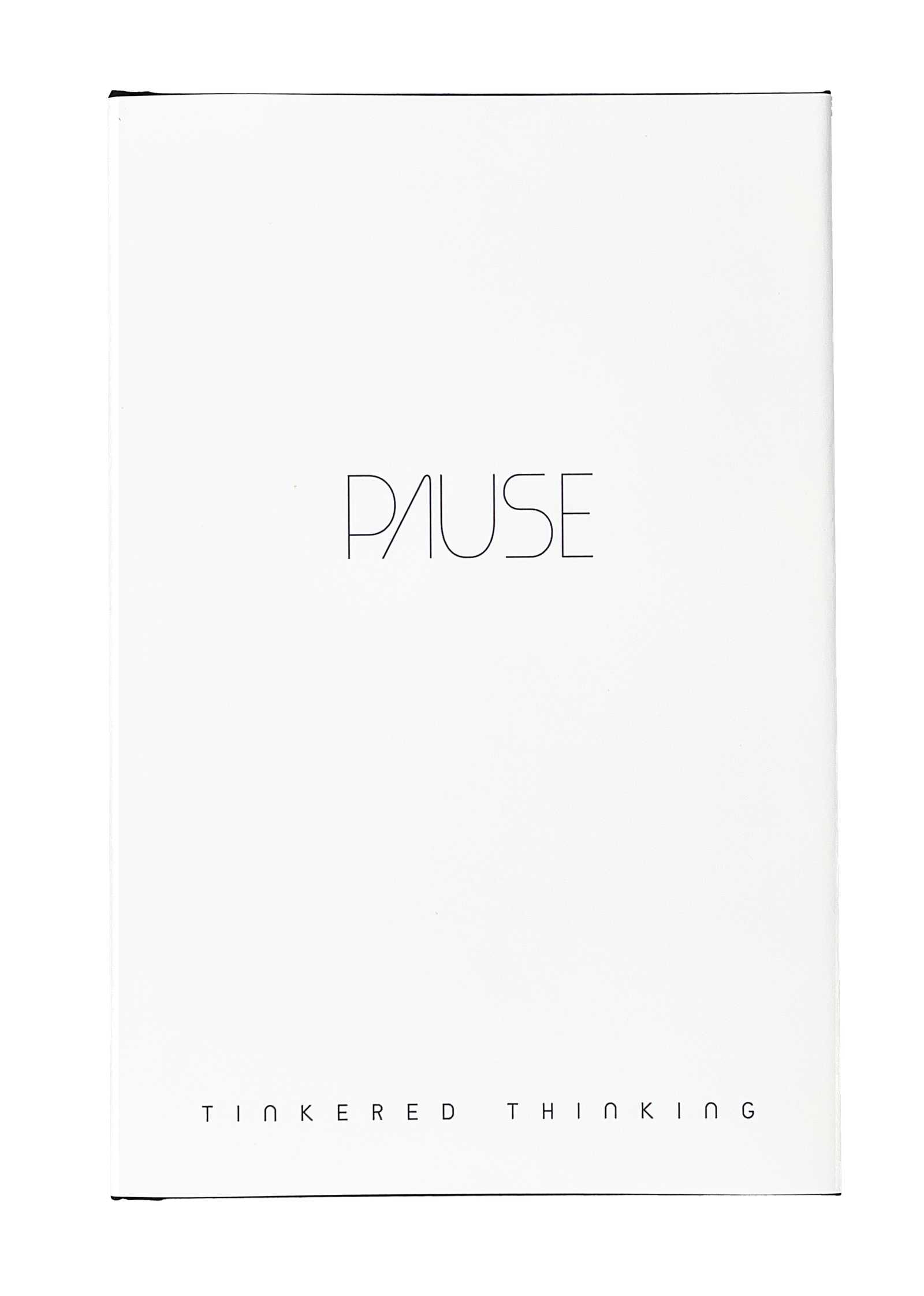
The first non-fiction book from Tinkered Thinking. PAUSE is a short book on meditation. Now available on the Tinkered Thinking Bookstore.
The SECOND illustrated book from Tinkered Thinking is now available!

SPIN CHESS
A Chess app from Tinkered Thinking featuring a variant of chess that bridges all skill levels!

REPAUSE
A meditation app is forthcoming. Stay Tuned.




HEADWAY
July 21st, 2018
Take a cue from the very thing that allows you to read and understand this sentence: your brain.
A neuron only fires if it gets enough stimulation.
A couple of weak pulses from connections to other neurons and nothing happens.
A few tepid practice sessions with some new activity . . . and nothing happens.
But if that neuron gets a strong enough input. . .
or weak signals from a whole bunch of connections . . .
BOOM, it fires off like a lightning bolt.
Put in a really strong effort. . .
or stay consistent with small efforts, and over enough time . . .
BOOM, a little breakthrough.
How we operate (Literally) on a microscopic level is also how we operate on a day-to-day level.
Feel like a moron, banging your head against something new?
Just keep at it. The right neurons will fire eventually, and then appropriately, you’ll start making headway, literally.

THE GREATEST TEACHER
July 20th, 2018
Without failure there is no progressive iteration.
Failure is far more capable of showing a precise error than success is capable of revealing the reason for success.
Success may mean simply that nothing went wrong, but this does not really reveal what actually went right, because this is generally a large concert of things.
Failure on the other hand can be narrowly identified. It can be measured, inspected and analyzed.
Analyzing success is far more difficult. So difficult that it could possibly be a waste of time.
Since time is the most valuable resource, it becomes the center of the question:
What will take less time? Iterating through failures and identifying small, measurable flaws that can be corrected for the next iteration? Or trying to analyze the elements of success and then copy those elements perfectly?
A concentration on failure may at first seem negative. But such a concentration is more agile and in the long run honors our goal more intimately.
This episode piggy-backs off of Episode 77: The Proper way to Fail. If you’d like to fully understand that reference, please check out that episode next.
WHAT IS SACRED?
July 19th, 2018
Theorists fall in love with their theories.
Academics fall in love with their ideas.
Artists fall in love with their creations.
(Good) Scientists abandon what doesn’t work. They are engaged with a very honest version of reality. One that gives feedback honestly and unapologetically. Theorists on the other hand, like academics and artists, can easily fail to have a metric by which to measure the usefulness or accuracy of their ideas. Their sustenance does not necessarily depend on accuracy or tracking a metric. They are storytellers, living in their own story. The good scientist has to constantly edit their story, their version of reality in order to keep interacting with reality in a meaningful way.
The good Scientist holds that nothing is sacred, not because of some despicable hate or evil. But because of a far more nuanced reason. One that requires another question:
What does ‘sacred’ mean?
We all have an emotional definition for the word. But have we consulted the origins lately?
Sacred is late Middle English, the past participle of the archaic sacre or ‘consecrate’, form the Old French sacrer, from nearly the same spelling in Latin, sacrare with an ‘a’, from sacr, s-a-c-r, meaning ‘holy.’
Well. Where does this rabbit hole lead? What does holy mean? We all have an idea, but have we consulted the dictionary lately?
‘Holy’ comes from the phonetically obvious whole, spelled with a ‘w’ in front. We all have an idea of what that means, but it goes just a little bit deeper. Whole is related to ‘hail’ as in ‘all hail the king’. And ‘hail’ simply means ‘healthy’.
Now, etymology followed in this roundabout rabbit-hole sort of way is not meant to function like a mathematical proof. Words are constantly shifting in their meanings and to try and pin them down to non-negotiable certainties is a fool’s errand. But the associations here are quite ripe.
If we go back to the good scientist and ask, what is such a person seeking? The answer is quite humble. The good scientist merely seeks an accurate understanding of what’s going on. The good scientist is trying to see the WHOLE picture (Spelled with a double-U). And apparently, this is a healthy endeavor. One might even make the claim that, etymologically, it’s the only legitimately sacred endeavor.
The alternative is to make the mistake of thinking we have the whole picture when in fact we don’t. Why is this an important thing to realize?
For the same reason we’d like a bridge to be sound and whole before we drive our car over it.
Suddenly a vegetable smoothie can become a sacred thing, merely for the reason that it helps us be a little healthier than we would otherwise be.
But the only way to discover what is sacred to ourselves personally is to be like the good scientist and DO experiments, compare outcomes and see what leads to a better, healthier life.
This episode references Episode 77: The Proper Way to Fail, Episode 53: There is No Try, and Episode: 94: Bad Narrative. If you’d like to fully understand those references, please check out any of those episodes next.
BAD NARRATIVE
July 18th, 2018
Why do we go to the cinema?
Why do we binge on Netflix?
Why do we have libraries stuffed with good and very bad fiction?
Why do we talk, gossip, pontificate and lecture?
The common thread of all these questions is the core reason why humans suck at improving. All of these questions are about our love of narratives.
Who doesn’t love a good story?
But what qualifies a story as good? Many of us are familiar with ‘formulas’ that used to make stories sticky. Stories follow arcs. Nearly every James Bond movie starts off with a tense dramatic scene. In the Matrix the movie starts out with Trinity in room 303 and dramatic climax of the movie ends with Neo desperately trying to escape the Matrix by getting back to the same room. This is a not coincidence, but a conscious design feature built-in because humans respond so viscerally to it, whether they realize it or not.
Just as commercial song writers are constantly trying to write the next good ‘hook’.
Some of these formulaic structures can be traced back to ancient times. For example, most of the the epics, such as the Odyssey, the Illiad, the Epic of Gilgamesh, and even certain parts of the bible, among many others employ a formula called ‘Chiastic Structure’ or ring structure. (The incidence of Neo arriving at the same room where the movie starts is one instance of this formula.)
But what do stories and their structures, whether they be formulaic or not, have to do with improving who we are as humans, as individuals, and together as people?
The problem is that the ‘narrative’, the story, seems to be an intrinsic part of our species’ psychological syntax. We seem to need stories. And this need can trap us if we are telling ourselves a bad story. As long as the story fist the needs of our syntactical psychology, we will play that son on repeat, and that broken record can go on for years, even if it’s not enjoyable. Like tonguing the cut in the roof of your mouth. You suspect that things could change, that the cut could heal, if only you stopped playing the record. But the off switch seems to be buried deep in the cluttered, chaotic, and bizarre parts of our subconscious. Or is it? Is that just another part of the bad story we tell ourselves. What if the story becomes: it’s not so complicated to change one’s self. In fact, merely thinking that it is a complicated endeavor is what makes it so hard.
Who cares if the turntable doesn’t have an off-switch. Rip the record off and toss it against the wall.
Turn off Netflix.
Realize there is a formula that’s fooling you.
Just PAUSE, think about something simple to improve. Something that would actually make daily life better. And design an experiment. A simple experiment. And run it. Compare the outcomes.
Here’s an example.
What would happen if I drank a liter of blended vegetables every day for 2 weeks?
Most people would respond by saying “I could never do that.”
And of course they would say that. Such thinking, and such doing is not a part of their narrative. It doesn’t sound like it would fit well into the dopamine-squirt living that we seek on a moment-to-moment basis.
But if we say ‘to hell with the story we’ve been telling ourselves.”
If we say, let’s compare outcomes.
Let’s actually DO something, and see if there’s a meaningful difference.
Then we can start to iterate our actions.
This is a new narrative. This is the narrative of iterating our own personal story towards a goal of a better personality, a better lifestyle, better relationships, and a greater, more mindful experience of what it means to be alive.
While it is not necessary to ask this next question. Because doing and experimenting are far more powerful than merely thinking about a new narrative, it may function as an important pillar in the narrative of motivation to rip down the current bad narrative and clear space for a better one.
“Why am I so attached to the way I think and the way I live now? Why do I believe the stories that have been handed to me. Is it because these stories are actually good for me and help me live a better and better life? Or is it merely because they play into a certain structure of thinking that is common to all human beings?”
We must remember that the aspect of whether something is convincing or not, is separate from whether something is good or beneficial for us or not.
Something can be very convincing, and also very bad for us.
Propaganda and the techniques used by cults and gurus are fair-game examples of how this idea can be obvious.
Likewise, we must remember that something can be very good for us, while failing to be convincing at all.
The only way to suss out the difference regardless of how convincing something happens to be is to run an experiment. To DO something new, And then compare the outcome to how we were living before.
Notice how this perspective, this challenge, is a new narrative. It’s a new story to tell one’s self. But unlike all other stories we can tell ourselves and narratives that we may unconsciously live by, this one is literally a build-in shit detector. It is a narrative that is designed to change itself and evolve towards something better because of that one initial call to action: Do something new and compare the outcomes.
This episode references Episode 23: Pause and Episode 53: There is No Try. If you’d like to fully understand those references, I suggest checking out those episodes next.
THE GENERATOR
July 17th, 2018
What does it mean to be generous?
Giving, kindness, benevolent, unselfish…
Who has the ability to be generous?
This is a much trickier, stickier question, because we are quick to associate a word like ‘giving’ with the things that we might have the ability to give, and those things are easiest to think of as a physical item, like some expensive gift. Our quick and bad thinking leads us to believe that only those with lots of things or capital have the ability to be generous.
However, such a cursory glance at the word generous betrays a deeper meaning.
Again, etymology provides an interesting turn in the rabbit hole.
The first four letters of the word: gene- is a root that means
give birth.
This root is obvious in other words like genesis or genetic.
So what does it really mean to be generous if it has a root that means birth? Our lazy thinking about the word leads us to believe that we need to have some rich cache from which we can dispense value to others, like having a fat wallet. But to give birth to something is to have something come into being from seemingly nothing. Where is that rich cache?
What really happens is that the right circumstances arise and allow for things to come together in ways they never had before.
Think of a wind turbine for a moment. The long blades of such a windmill create the circumstance for wind to expend it’s energy on those blades in such a way that the turbine turns and this gives birth to some electricity that we can then use in countless other ways.
The strange and misleading thing about the word generous is that we only attribute it to things that we like, that feel good, and that generally benefit us. But if we lift this connotation and think about the word, it can yield a helpful perspective. For example, think about this sort of zen koan:
He’s so generous with his complaining.
On first read, this just sounds amusing and possibly poking fun at the person who complains. But with the positive connotation lifted, and that original meaning of ‘birth’ kept squarely front and center, that sentence makes perfect sense: He generates many complaints.
Another way to say is this: He chooses to pick and take negative aspects of his day-to-day life and combine them into complaints. He is a complaint generator. His perspective is the circumstance that is allowing for things to come together and give birth to complaints.
The word ‘generator’ has a fairly neutral feeling attached to it when compared to a word like ‘generous’. And yet, they really mean the same thing.
A fat wallet is not needed in order to be generous. The truth is, we are all being generous at all times. But we have to ask the question: what exactly are we generating?
It’s poignant to remember that saying: give a man fish and he eats for a day, but teach a man to fish and he’ll eat for life.
Generally we only think of the first half of this saying when we think of what it means to be generous.
It’s interesting to note that the second half – teaching a man to fish – requires some effort on the person who is receiving the generosity in order for the generosity to work. Whereas the first half – give a man a fish – allows the man to be lazy, in fact, traps him into a laziness because comparatively no effort is required.
Upon hearing the saying, we are quick to realize that teaching a man to fish is far more generous. And this makes sense on a deeper level with the meaning of generous. Teaching a man to fish gives birth to a new skill that perpetuates through time, where merely giving him a single fish only temporarily solves the problem. Teaching a man to fish gives birth to the man’s ability to generate his own food. In this way we can see that generosity, true generosity is actually recursive, in that it repeats itself. Think about how gossip generates more gossip and people are more likely to respond to a complaint with another complaint.
We must ask:
Are we generating a better world around us? Or are we generating complaints and negativity and unneeded hyperbole, and destructive drama and slowly converting reality into a worse one?
Clearly we know which one we’d prefer, and this is maybe why the word generous has such a warm, fuzzy reputation.
So the question stands: What are you generating?
Would another person call it generous?