-compressed.jpg)
Daily, snackable writings to spur changes in thinking.
Building a blueprint for a better brain by tinkering with the code.
subscribe
rss Feeds
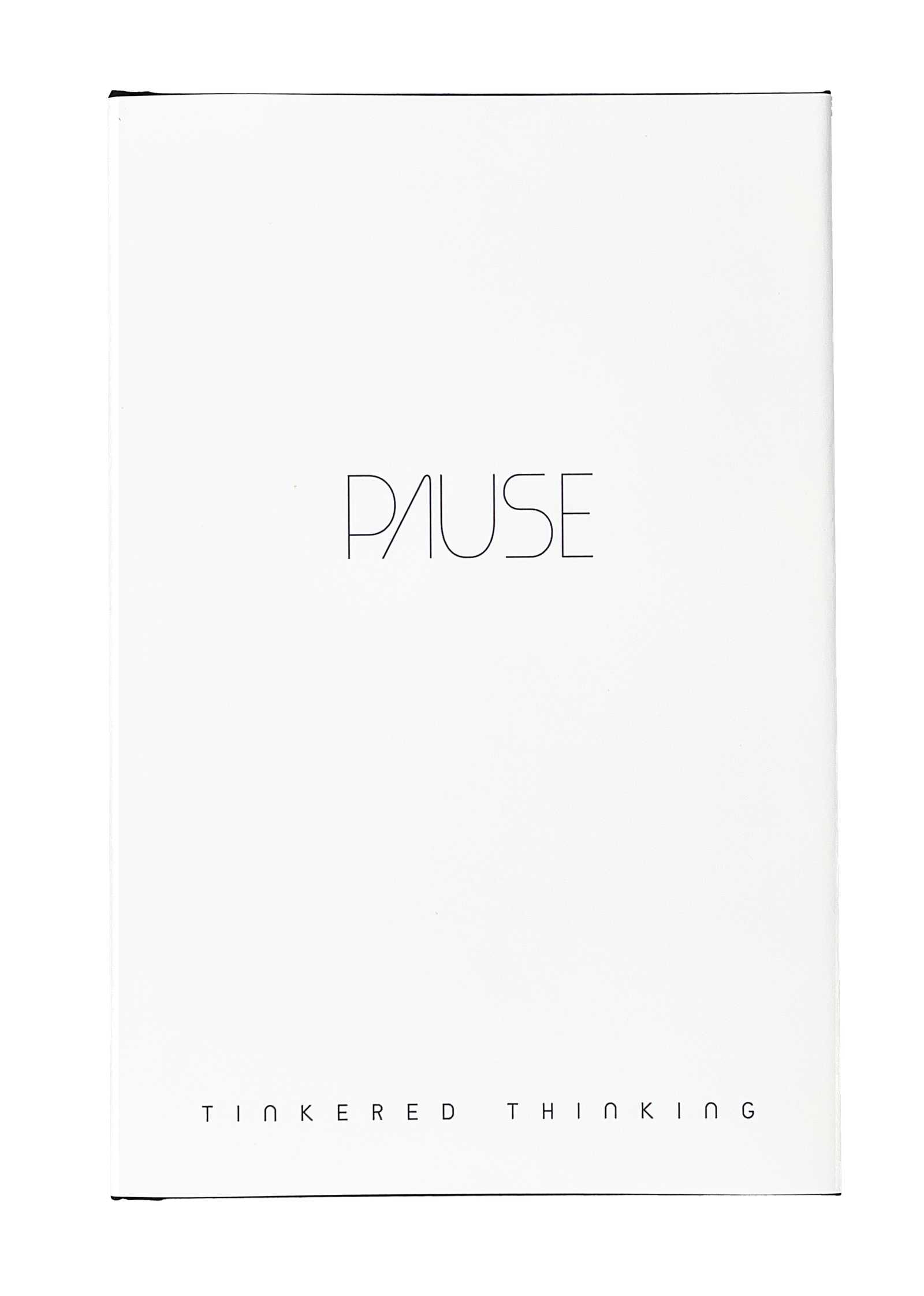
The first non-fiction book from Tinkered Thinking. PAUSE is a short book on meditation. Now available on the Tinkered Thinking Bookstore.

The SECOND illustrated book from Tinkered Thinking is now available!

SPIN CHESS
A Chess app from Tinkered Thinking featuring a variant of chess that bridges all skill levels!
REPAUSE
A meditation app is forthcoming. Stay Tuned.




PAUSE
May 8th, 2018
What did you do that last time someone offered a suggestion?
Did you respond immediately?
Or did you pause.
Did you consider?
Did you think.
Or
Did you simply feel. Express that. And then move on to what you were waiting to say.
The ability to pause is like a muscle in the brain. It requires training and vigilant exercise: constant use.
It’s the block of marble that is continuously growing back to the dull boring shape of a block. A masterpiece cannot be chiseled out once and expected to keep forever. It must be continuously chiseled.
A big task.
But once the hard work of moving most of the unneeded stone is done. Every day is just a small bit here and there, like sanding away the fat. Maybe after a lazy week the chisel needs to be used.
This is the ever-giving benefit of good habits.
Once they are formed?
They have their own momentum.
Friends and family might be out of touch with who you are and what you want to become, and therefore unable to give good advice. But anyone who truly listens and cares will have something useful to say.
Next time it happens. Will you have your chisel ready?
Will you pause?
It could spur a habit that changes your life.
Even if the advice is bad.
DID YOU NOTICE A DIFFERENCE?
May 7th, 2018
If we have to ask, the answer is no.
If we ask and the answer is yes?
Then it wasn’t much of a difference. We had to ask someone to apply their attention. Their attention wasn't caught in the first place. And if it was, it’s telling that the difference didn’t spur a comment on it’s own...
Why do we even ask?
Feedback?
Rarely.
We want Reassurance.
Why do we need reassurance? What’s the root of that empty hug?
If our practice is strong enough, if our work is dedicated, if our effort is honest and thorough, if our eye is on the prize, then the question does not even arise in the mind.
If we feel the need to ask. Perhaps we are already losing focus on the project.
Work speaks for itself.
THE MONTAGE IS FALSE
May 6th, 2018
Movies do us a great disservice. We like to classify such movies as entertainment, but could they be functioning beyond such a deceptively innocent category?
It’s just entertainment. Right?
Or maybe…
From an early age we are exposed to stories that occur completely in just a couple hours. And yet extremely few movies are about a two-hour stretch of time.
They skip all the boring parts.
At the very most: the important, slow, methodical, dull work of attaining the skill, trekking the distance, writing the book, building alliances is crammed into a montage.
Of course, no one would watch a movie that faithfully represented these time-consuming activities. There’s good reason for the montage.
But what effect does it have?
How often is the complaint made that we are a people constantly seeking instant gratification?
A people constantly expecting instant gratification watching stories that show only the humble beginnings followed immediately by the long-term results: for the movie-goer these are instant transformations from non-entity to master, from slave to conqueror, from meek 9-to-5’er to savior of humanity.
Oh but we know it’s time compressed. Oh but we understand how much time, how much effort, how much trial-and-error went into all that stuttering success.
But do we? Does every part of our brain get that message loud and clear?
Or do we deceive ourselves? Assuming we are smarter than we actually are.
Here’s a great quote: “If the problem was just a matter of getting the information, we’d all be billionaires with six-packs.”
The point is we don’t have as much control of ourselves as we like to think.
It’s best to assume with caution: I am probably being influenced in ways I don’t even realize. Hey, remember subliminal advertising? We all know about that? What else is functioning in exactly the same way as subliminal advertising, but isn’t necessarily geared toward selling something? Maybe it hasn’t been consciously geared at all. Maybe it’s just a product of culture that is effecting us in ways never intended nor dreamed…
How do great things happen?
With a bang? Nope.
In the same way that the old woman with the walker looks in the mirror and wonders what happened, feeling that young sex-kitten still alive and aglow in her. The same way the 400lb man looking at his bypass scare wonders how he was once a baseball player.
All this happens because of two things:
Time + a trend.
Great achievements require time and lots and lots of slow dull consistent work. Time is the same for all of it. But here the trend is work.
For the man, the trend is unhealthy eating.
And if a woman can have this routine at 91 years old? No one decades younger should have a walker.
A trend can also be a lack of something. In the case of the old, frail woman: inactivity.
Given enough time, trends result in extreme examples.
Are you trending in the right direction?
Check now and make changes. Because you can be sure as certain:
There’s not going to be a montage to teleport you to some wonderful version of your life.
REVERSE ENGINEERING
May 5th, 2018
- Mom, see? It works.
Once, when I was a young child, my mother came home from work and found most of the appliances in our house completely dismantled.
She was startled to say the least. And then very very upset.
In hindsight, I see that she assumed that all the appliances would have to be repurchased and this would cost a great amount of money. Among other things, I had taken apart the T.V., the stereo, the remotes, the blender, even the toaster, and I believe I was puzzling over the fridge when she walked in.
I was genuinely confused by her reaction.
I had seen it all taken apart - I’d done it. Therefore, I knew how it all went together.
It wasn’t until hours later, after I’d snapped and screwed everything back together and turned everything on to show her it all still worked did her tumultuous emotions on the subject subside.
Most of these appliances were just mysterious black boxes. In metaphor, all of them were.
I was just curious.
- No really, go ahead. I mean it.
Years later when I was an art teacher, I was warned about one particular student who was going to be part of an incoming class. She was a little devil, they said. They couldn’t figure out what to do, but any class she was in just dissolved into chaos.
I was teaching basic origami to these 5-7 year olds, and the first few classes went as predicted. 5-10 minutes of good steady class, and then somehow things snowballed into chaos so quickly, it was hard to pick out how it happened.
Let’s call this little devil Kailee.
After the third class, I inspected Kailee’s work. From the disheveled little paper boat, I could see that her dexterity was still developing, but she definitely had full command conceptually of what she was doing. All the right folds were there, even if they weren’t executed perfectly.
The next class, I watched her very closely. She followed instructions for about 5 minutes, and then started looking around the small table of kids. She started with a question or a comment or an observation. She knew just what to say and just who to say it to. This was the little devil part.
What might have gone unnoticed though, was that while the other kids were still working through the instructions, Kailee had rushed through them, and was finished.
My analysis? She was bored.
And the rest of the class provided for an interesting experiment. A grander reality that she could poke for feedback.
I wondered.
The next week I started class as usual. But once I’d given the first set of instructions to occupy the kids, I took Kailee aside.
This had obviously happened to her many times already in her short career at school because her face was displaying all the emotions of a child about to be singled out for reprimand and exile.
I took her to the other side of the room and revealed a finished piece of origami that was far more advanced than what the class was doing. It was a modular piece that incorporated many pieces all interlocking in an ornate way. I placed it in her cautious and careful hands.
“I want you to make one of these.”
Challenge presented. Opponent intimidated.
“.. and I’m not going to show you how to do it. You’re going to show yourself.”
Opponent very intimidated.
“Take it apart,” I said.
She looked at me with surprise and suspicion. What was this ‘adult’ trying to pull on her. What trick is this?
“No really, go ahead. I mean it.”
She carefully took the piece apart, and I asked her what she could tell me about all the pieces.
“They’re all the same.”
So I took away all the pieces but one.
“Take it apart.”
And when she had unfolded the one module back to a square piece of paper, I said:
“See, all these folds are familiar. You know how to figure them out. How to start with the center fold and use that to create the others. Which means you can figure out how to make this, because you’ve got all these others as models to show you if you’re doing it right.”
Then I pulled out another piece of modular origami identical to the one she had just taken apart.
“And then you can use this finished one to figure out how they all fit together.”
As a teacher, there’s no better sight than a kids face while their brain is racing, figuring, anticipating.
“To be honest, I don’t know if you can do this. And if you can’t, that’s totally ok. But I wanted to see if you could give this a shot. What do you say?”
She nodded. Her face was: Lit. Up.
- Staircases & Wells
Stairs are a wonderful invention. Flip them upside-down and they still work. And using them works in a likewise fashion. Flip the way you use them and they perform in a symmetrical fashion.
Vicious and Virtuous cycles are very much the same.
A vicious cycle is perhaps best visualized as an evil whirlpool. Spinning slowly at the upper wide edge, gently coaxing things into it’s path and speeding up slowly, like the heat slowly rising in a pot of water where a frog sits. Give the trend enough time and that vicious cycle is spinning like mad and that frog is dead in boiling water.
Turn a vicious cycle upside-down and it’s best seen as a swirling pyramid, or the exhaust plum of a spinning rocket: that’s your virtuous cycle. They look the same, just flipped.
Give either a little time and we get to an extreme place that seems to have a lot of momentum.
So much momentum that the worst places that vicious cycles can bring us can feel more like the bottom of a deep well, not a staircase.
But neither metaphor is perfect. All metaphors are flawed.
A better one at this juncture is a hole we’ve dug ourselves.
Sure, life can suck. Deal you blow after blow. And such explanation is a good holding pattern for those who have decided to be victims of circumstance. It’s not a holding pattern though. It’s more like the slow circular coaxing of that whirlpool. It seems to just be going in a loop, but it’s also descending.
The brain is the sole architect of it’s current thinking. If it can think it’s way into it’s current state, it can reengineer it’s thinking to make a way out. This doesn’t mean ruminating: the favorite activity of vicious cycles. This means using the mental processes that got the brain to this state against the current state.
A lot of this is counter-intuitive: for example, if thinking obsessively about this bad thing helped get me to this bad state, how can I not think about it? Possible solution: go work-out. Not only does that give your mind a radically different activity to navigate but the neurological byproducts of the activity have subversive effects on a depressed brain. The effect feels as though it changes from the inside out, magically.
That’s just one little strategy. Many must be built, found, implemented, practiced-into-habits, etc.
- A GAME OF CHESS
In epileptic patients, the corpus collosum is sometimes cut. This is the area of the brain, right in the middle that allows the left and right hemispheres to talk to each other.
In epileptic patients, when you cut it, seizures decrease by a lot. But some other weird properties of the brain get highlighted…
One woman gets slapped by her left hand (controlled by her right brain) every time she does something bad, like swear or smoke a cigarette.
In other experiments, people with severed corpus collosums will have the name of an object, say “Egg” flashed in their left visual field so that it will only be seen by the right hemisphere. Then they will be asked to select an object from behind a screen with their left hand (also controlled by their right hemisphere). They will invariably pick the egg. But when asked why they chose the object they will fabricate some bullshit association, like “Oh I had eggs a couple days ago, so I was thinking about it”. Speech is controlled by the left hemisphere, which didn’t see the name of the object, nor did it control the hand that picked the object, so it just makes shit up!
If asked what they hoped to be as a child when they grew up? They will say something different than what the left hand will write.
These findings make one wonder: are there two people inside of all of us?
Are decisions only reached after a back-and-forth between these two halves? Like a game of chess.
How do you ‘check’ your brain and force a move in a better direction?
An upward direction.
A virtuous direction.
- PRINCIPLES OF THE AUTODIDACT
Teachers are generally overwhelmed. People who are overwhelmed do not notice the nuances.
(Somehow it goes that a university professor teaching a relatively benign set of adults is equipped with a tiny team of teaching assistants that do most of the grunt work, but a single 3rdgrade teacher is expected to sail a ship with a bunch of tiny humans who are only partially developed.)
I was lucky when Kailee entered my classroom. I had been warned. And I took that warning as a challenge. I was poised to observe. I knew the only way I could have a chance of making a difference is if I first understood. For that I needed to watch and learn something.
Once I observed what Kailee did in class, I hypothesized that she was just really smart and really bored.
I wasn’t sure I was right. So I needed to test my hypothesis.
I gave her brain something difficult to gnaw on.
* * *
One action that starts a good habit is a virtuous action. If repeated enough times, in a short enough span of time (say, a month), it can start to gain momentum. Eventually it will ‘lift off’ and fly on it’s own to a better place, taking you with it.
That might sound easy, but it requires work. It’s like starting at the bottom of that well and slowly carving a spiral staircase into the wall. A big task. But carving just one step allows you to take a step up.
If we have dug ourselves into a hole, the answer is not to keep digging down, and digging up is nonsensical. Sometimes you have to dig sideways. Like a riptide.
* * *
I didn’t just hand Kailee a complex piece of origami and say “here, make one of these.”
I showed her the principles of teaching herself. The principles of the autodidact.
She knew them well already, but in the context of the finished piece of complex origami, she was afraid to do it.
First you have to observe.
But just observation. Gets. You. Nowhere.
Second, we must form some kind of understanding from that observation. That understanding may be flawed. It probably IS flawed. But the only way to improve that understanding is to get more information. The only way that is achieved is through:
Action.
That means poking reality.
In Kailee’s case, that meant taking it apart. Methodically dismantling it. And observing all the while.
* * *
Buried within the message itself is the key to decoding it: the blueprint for a virtuous cycle is identical to the vicious cycles that have taken us to such low places.
As outside observers the mistakes of friends and family can seem… painfully obvious. But the perspective is a privileged one. Mirrors are only useful in the most superficial sense.
* * *
Kailee was observing her classmates, forming an understanding about them, and then poking reality to test her understanding. She was already a master of manipulating the classroom, and every time she created chaos she was learning, sharpening her understanding.
I just gave her something that was just as juicy and interesting. Something difficult.
As we gain awareness of ourselves, we can do this to ourselves. Observe, understand, poke, tweak the understanding & poke again. and again. and again.
We are our own black box. Don’t assume you know what’s inside of it. You have to test constantly to find out.
* * *
Are you faithfully observing yourself?
Are you poking reality, and observing how you change?
* * *
I went back to the rest of the class and continued as usual. I’ll be honest. I totally forgot about Kailee.
When class ended and parents were arriving to collect their kids, I got a small tap on my elbow. I turned around and there was Kailee.
The smile on this kid. . . my god.
I looked at what she gingerly presented in the center of her two cupped hands and smiled.
“Look what you did. You made that, and you taught yourself how to do it.”
THE RIGHT QUESTION
May 4th, 2018
We have an unfortunate design in our hardware. When faced with a difficult question that is worded in a deceptively simple way, we don’t answer it. Instead, we create a very similar sounding question that is not only simply worded but also a simple question.
Compare these two questions:
Is it the best solution?
VS.
Do I like the solution?
These are NOT the same thing.
The first question is a difficult one. It requires breaking it down into many different questions: What are the metrics that we will measure success of the solution with? What sort of actions do we need to take to get any kind of register on these metrics? Even when all these questions are formed, they still aren’t answered. That takes testing. It takes action. That takes time and work. So answering this question is no simple matter. Certainly not something that can be done quickly.
The second question is easy. It glosses over all the deceptive complexity of the first question and seems like the same question. This requires less work for the brain. We simply consider the solution and then see how we feel.
This weird substitution crops up in our thinking in all sorts of ways and places.
The Wall Street Journal published an interesting little blurb a few years ago about the phrase “I don’t have time.”
The Journal instructed substituting “I don’t have time” with “It’s not a priority.” And see how you feel. Here’s a couple good examples: “I don’t have time to workout” vs. “My health is not a priority” and… “I don’t have time” vs. “Spending time with my child is not a priority”. Saying one of these is waaay more difficult, even painful. Just in the same way that “Is it the best solution?” is a much more difficult question to answer.
Another area of our thinking where this kind of substitution occurs is on a marco level. Whenever something akin to the phrase ‘victim of circumstance’ or ‘yea, but’ comes into our thinking or our speech, we need to tread carefully and examine what’s going on.
Is someone overweight because of the circumstance? Because of the circumstance of their genes? Because the financial circumstance doesn’t permit for better food and gym memberships? Because the circumstance of schedule doesn’t permit time? All of these combined, feel, compelling.
We are very adept at coming up with more and more reasons to support the conclusion that we are a ‘victim of circumstance’
Think of all the times when a friend is venting about an issue and in response to every solution you try to present, there is a response that starts with “yea, BUT . . . blah blah blah”
All of these substitutions occur because of the same thing: It’s simpler and easier.
To answer the easier question.
To phrase things in a way that leaves us blameless.
To phrase things in a way that blames things that are out of our control.
How much better would life be if we consistently opted to do the good, hard work?
Hard questions require slowing down and remembering that they can be worded in deceivingly simple ways.
Everyone has the same amount of time, so if someone else can prioritize fun things like family and curiosity, so can you – it just requires an honest look at that priority list, some innovative thinking and action.
So are you a victim of circumstance?
Or is that an easier, simplified question? Perhaps the better question is. . .
Am I a victim of my own thinking?